HOME PAGE * SEARCH * UK KS3 level Science Quizzes for students aged ~13-14

UK GCSE level Biology * Chemistry * Physics age ~14-16 * Advanced Level Chemistry age ~16-18

School-college Physics Notes: Forces & motion Section 4.1 Newton's 1st law and inertia

GCSE level Physics exam revision notes on Forces & Motion Part 4

Forces and Newton's Laws of Motion 4.1 Newton's First Law of Motion, the concept of inertia and resultant forces

See also 4.4 for

More on the concept of inertia, examples of inertial mass & gravitational mass

AND see also Forces Part 3. for more on resultant forces

Calculating resultant forces using vector diagrams


[Author © Dr Phil Brown GRIC, PhD: Doc Brown's physics exam revision notes suitable for students of UK IGCSE & GCSE level physics courses, ~ US grades 9-10 physics [forces-motion-4 updated RE-EDIT]

[KEY POINTS and learning objectives for this page, after initial notes]

INDEX of notes on Newton's Laws of Motion: concepts, formula, calculations, problem solving

 email doc brown: comments? query? * [privacy & cookies policy & disclaimer] * [SEARCH]


4.1 Newton's First Law of Motion, inertia and resultant forces

See also 4.4 More on the concept of inertia, inertial mass and gravitational mass

What is Newton's first law of motion?

Newton's three laws of motion are some of the earliest proposed laws of physics - indeed of science itself.

His imagination, insight and mathematical brilliance have stood the test of time since 1686 when he first proposed them - but they could not be assumed to be true i.e. valid in 1686 - repeated experimental verification is required.

BUT, countless experiments over the past few hundred years have shown them to be true and form the basis of innumerable calculations in applied physics and engineering.


Newton's First Law of Motion

 BUT 1st, knowing what inertia is helps

Inertia is not a force - it’s a fundamental property of matter and refers to an object's resistance to changes in its motion.

The greater the mass, of an object, the greater its inertia (harder to change its motion) i.e. a greater force must be applied, the greater the mass, to move it.


Newton's First Law of Motion states that a resultant force is needed to change the motion of any object.

Below I've expressed Newton's 1st Law in various ways!

An object will remain at rest or move at a constant velocity unless acted upon by a resultant (net) force.

If the resultant force on stationary object is zero, it doesn't move!

e.g. starting a body moving, increasing its speed (acceleration), slowing it down (deceleration), stopping it moving, changing the direction of movement (the latter is a change in velocity).

If there is no resultant force, from Newton's 1st law, the motion of the object is unchanged, stationary or moving with a constant velocity.

A resultant force must be an unbalanced net force of >zero on an object.

If the resultant force on a stationary body is zero, the body will remain stationary.

If the resultant force on a moving object is zero, the velocity remains unchanged, in other words the object will continue moving at the same speed and in the same direction, therefore moving with the same velocity.

If a body such as a road vehicle or an aeroplane is moving at a constant velocity (constant speed without changing direction) the driving force from the engine and the resistive forces of friction (moving parts, air resistance etc.) must be balanced i.e. the resultant force is zero.

The velocity can only be changed if a resultant non-zero force acts on the object.

Constant velocity means constant speed in the same direction.

Realise a moving object can fit in with Newton's 1st Law and moving objects will only come to a fault if a force is a applied e.g. an object rolling on any surface will to a fault from the opposing force of friction.

A non-zero resultant force will always initially produce an acceleration or deceleration in the direction of the force.

There are five situations that you will come across when dealing with a non-zero resultant force that results in a change in velocity.

This change in velocity may involve a moving object speeding up (acceleration) or slowing down (deceleration).

The acceleration might be a stationary object being forced to move or a moving object made to stop.

These first four situations involve change in speed, and not necessarily a change in direction, but change in direction is also a 5th result of the effect on an object of a non-zero resultant force, and therefore a change in velocity.


See also Forces and motion section 3.

Calculating resultant forces using vector diagrams, also includes work done calculations

See also 4.4 for

More on the concept of inertia, examples of inertial mass & gravitational mass

AND also Forces Part 3. for more on resultant forces

Calculating resultant forces using vector diagrams


Lots of examples of applying Newton's First Law of Motion

(a) Any stationary object standing on a surface and Newtons 1st Law

The weight of an object, due to gravity, acts on the surface - normal contact force.

The atoms of the surface are compressed and push back up with an equal normal contact force.

The resultant force is zero.

Therefore from Newton's First Law of Motion, the object should stay stationary.

If there was any difference in the two forces, the object would accelerate and rise or fall.

According to Newton's 1st Law, no standing object will move until an external force is applied to it e.g. pushing a book along a table or lifting it up.

Note that the heavier object has a greater inertia so a greater force is needed, e.g. its easier to push a book along than move a sofa!


(b) Applying Newton's 1st Law to some examples involving circular motion

(i) Suppose you whirl an object around tied to the end of a string.

If you supply kinetic energy at a constant rate the object will whirl around with a constant speed in the same repeating circular path.

The object is held in a constant orbit by the tension in the string - the centripetal force, acting towards the centre of rotation, and balancing out the acceleration.

The forces are balanced, a zero resultant force, but what if the string breaks!?

The tension in the string has gone, so there is no balancing centripetal force, but the object is still moving and shoots off at a constant velocity in a linear direction at a tangent to the original orbit.

(ii) The Earth orbiting the Sun

A thought experiment! Suppose you could switch off gravity, what would happen to the Earth.

(OR imagine if the Sun suddenly disappeared, its the same effect, the Earth is NOT in a gravitational field.)

The centripetal gravitational force has gone, so I'm afraid the Earth would fly off at a tangent to its original planetary orbit and fly off in a straight line at a constant velocity.

Unless it hit or was hit, by another object, it would continue in a straight line at constant speed for ever into deep space!

(iii) Artificial satellites

Satellites are put into a precise orbit to balance the circular motion of acceleration with the centripetal force of the Earth's gravitational field.

All is well at first and the orbit may be stable for many years, BUT, even in the very thin upper atmosphere, the satellite will experience friction from the drag force as it  passes through the air molecules.

So, eventually, Newton's 1st Law kicks in, and the satellite slowly (at first) heads downwards towards the Earth's surface, often burning up from friction in the thicker lower atmosphere.


(c) Some everyday situations of Newton's 1st Law

(i) The motion of a car cruising along will stay at constant velocity unless a resultant force is applied, so from Newton's 1st Law e.g.

 turning the steering wheel to change direction,

applying the friction of brake pads and drums, when braking to decelerate the car,

and also note on sharp breaking, the occupants of the car are thrust forward, you are then experiencing unbalanced forces, which is why you should wear the seat-belt!

or pressing the on the accelerator to increase he thrust force of the engine.

(ii) An object rolling along the floor, slows down and comes to halt due to friction from the floor surface or the air the object is passing through.


(d) Some of these ideas about applying Newton's 1st Law are illustrated using a cyclist

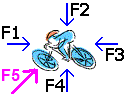
On the left is a 'free body force diagram' of a cyclist showing all the forces acting on the body.

If the cyclist is moving with a constant velocity then we are dealing with uniform or constant speed and no change in direction.

There is no resultant force i.e. F1 = F3 and F2 = F4, so the cyclist continues in the same direction at the same speed.


Note the relative size and direction of the arrows and think of Newton's First Law of Motion.

F1 is the air resistance due to friction between the surface of the bike and cyclist and the air, also friction between the wheels and road, and, friction in moving parts of the bike.

All three combined oppose the forward motion of the bike and rider.

F2 is the weight of the bike + cyclist combination due to gravity, weight of object acting on the road with the normal contact force

F3 is the thrust or push of the bike from the power generated by the cyclist.

F4 is the normal contact force of the atoms of the road surface pushing back up on the bike.

If the cyclist applies more power (left free body diagram), forces F1 and F2 are unbalanced, giving a resultant force of greater than zero from right to left.

Therefore the cyclist will accelerate and increase in speed. This action does not affect forces F2 and F4 which remain balanced. 


From Newton's 1st Law a resultant force causes the acceleration. 

If the cyclist applies the brakes (left free body diagram), in doing so he will stop pedalling, reducing force F3 AND the increased friction from the brake pads acting on the wheel rim will increase force F1 (left diagram).

Again, the arrows for forces F1 and F3 should be shown as unequal.

The forces are now unbalanced and the bike and rider slow down (deceleration).

Neither of these two actions affects forces F2 and F4 which remain balanced.


The resultant force causes the deceleration. 

If another force is introduced like a sudden gust of a side wind (F5), then the cyclist and bike will change direction in the direction of the wind i.e. forced to the right since the diagram indicates a gust of wind from the left.
Initially, there is then a resultant force and from Newton's 1st law, a direction change, until the cyclist applies a correction.

So, the cyclist will then apply a correcting 'balancing' force by turning the handle bars to adjust for the extra force F5 to try to maintain the same speed and direction of the cycle.


(e) You can analyse the descent of a parachutist

This is an interesting, but complex case because it involves an acceleration, a deceleration and two terminal velocities!

1.    2.    3.  

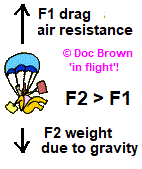
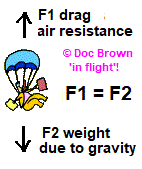
The three possible 'force' situations as the parachuting person is descending after jumping out of an aeroplane.

Note the relative size and direction of the arrows and think of Newton's First Law of Motion.

1. When drag force F1 is less than the weight force F2, the parachutist is accelerating.

2. When drag force F1 equals the weight force F2, the parachutist is descending at a steady speed - a terminal velocity.

3. When drag force F1 is more than the weight force F2, the parachutist will decelerate (to another terminal velocity).

This situation is fully analysed on Forces and Motion Part 3.5


More on the Complex behaviour of a falling parachutist: forces & velocities

The reluctance or property of an object to change its motion is called inertia.

See also 4.4 More on the concept of inertia, inertial mass and gravitational mass

INDEX for physics notes on Newton's Laws of Motion


Key revision points on Newton's laws of motion: Newton's First Law of Motion and inertia

Information sources for Doc Brown's key points: IGCSE-GCSE physics are based on textbooks & syllabus-specifications for students taking the UK AQA, Edexcel, OCR 21st Century Science, OCR Gateway science suite, WJEC, CCEA and CIE GCSE physics 9-1 level science examinations

A structured set of summary revision notes on Newton’s First Law of Motion, tailored to the GCSE/IGCSE Physics specifications across major UK exam boards: WJEC, CCEA, CIE, AQA, Edexcel, and OCR.

See also 4.4 for

More on the concept of inertia, examples of inertial mass & gravitational mass


Newton’s First Law of Motion – Summary Revision Notes

Definition (Universal Across All Boards)

An object will remain at rest or move at a constant velocity unless acted upon by a resultant (net) force.

This law is also known as the Law of Inertia.


Key Concepts related to Newton's First Law of Motion

  • Inertia: The tendency of an object to resist changes in its motion.
  • Balanced Forces: No resultant force → object stays at rest or continues at constant velocity.
  • Unbalanced Forces: Resultant force ≠ 0 → object accelerates (change in speed or direction).
  • Constant Velocity means:
    • No change in speed
    • No change in direction

Real-World Examples of Newton's First Law of Motion

Scenario Newton’s First Law in Action
A book on a table Stays at rest unless pushed
A car cruising at 60 mph Continues unless brakes or engine force changes
A spacecraft in deep space Moves indefinitely unless acted on by gravity or collision

Typical Exam Board Syllabus contents related to Newton's First Law of Motion

Specific Requirements

Higher tier students must recall the law verbatim; all students must apply it to real-world scenarios
Emphasis on inertia and balanced/unbalanced forces; apply to motion graphs and everyday examples
Must define and apply the law to constant velocity and resultant force scenarios
Apply the law to explain motion changes; understand balanced versus unbalanced forces
Use the law to explain constant velocity and resultant force effects; apply to motion examples
Apply the law to uniform motion and changing velocity; use vector diagrams and free-body diagrams (HT)

Common Misconceptions relating to Newton's First Law of Motion

  • “If something is moving, there must be a force acting on it.”
    Not true if it’s moving at constant velocity with balanced forces.
  • “Objects naturally come to rest.”
    Only happens due to friction or other forces counteracting the motion.

Student Tips relating to Newton's First Law of Motion

  • Memorise the definition - especially for higher-tier papers.
  • Use diagrams to show balanced versus unbalanced forces.
  • Think beyond Earth - space examples help clarify inertia.
  • Link to other topics like resultant force, acceleration, and Newton’s Second Law.
  • Practice with scenarios: cars, skydivers, trolleys, and space probes.

Newton’s First Law and Inertia – How They're Intertwined

Newton’s First Law Recap

“An object will remain at rest or continue to move at a constant velocity unless acted upon by a resultant force.”

This law describes how motion changes only when there's a net force involved.


What Is Inertia?


The Relationship between inertia and Newton's First Law of Motion

Concept Connection to Newton’s First Law
Inertia Explains why objects obey the First Law: they naturally resist changes in motion
Balanced forces Result in no motion change → inertia keeps object still or moving steadily
Unbalanced forces Required to overcome inertia → change in speed or direction occurs
Mass Directly affects inertia → heavier objects need more force to change motion

In essence:
Newton’s First Law describes the behavior of objects.
Inertia explains the reason behind that behavior.


Example Scenario relating to Newton's First Law of Motion

  • A passenger in a moving car lurches forward when the brakes are slammed.
  • That forward motion is due to inertia - the passenger’s body resists the sudden change in velocity.

More on INERTIA


Everyday Examples of Inertia

Inertia and vehicles

  • Seatbelt Safety: If a car stops suddenly, your body keeps moving forward due to inertia. That’s why seatbelts are essential - they apply a force to stop you.
  • Starting a Train: A heavy train takes a long time to start and stop because its large mass gives it more inertia.

Inertia and objects at Rest

  • Books on a Table: They don’t move unless someone applies a force - classic inertia in action.
  • Furniture: Large sofas are harder to push because they have more mass → more inertia.

Inertia While Moving

  • A Ball Rolling on Grass: It eventually stops, not because inertia ends, but because friction and air resistance apply a force to overcome it.
  • Shopping Trolley: Push it, and it moves. Let go, and it gradually stops due to friction - but inertia keeps it going initially.

Inertia of objects in space

  • Satellites: Once launched, they keep orbiting without further propulsion, unless acted upon (e.g., gravitational pull).
  • Astronauts Floating: In zero gravity, if they push off, they keep drifting - nothing slows them unless they bump into something.

In school experiments you see inertia, without realising it?

  • Pendulum Motion: A swinging pendulum continues until air resistance and gravity act on it.
  • Ticker Timer Tape: Shows constant spacing when an object moves at constant speed → inertia preserves the motion.

Keywords, phrases and learning objectives for Newton's 1st Law of Motion

Know and be able to Newton's First Law of Motion and resultant forces.

Know that a resultant force of >0 is needed to change the motion of any object.

Know what is meant by the inertia of an object and its relationship with Newton's 1st law of motion.


importance of Newton's First Law of Motion, inertia & resultant force in GCSE level physics, What you need to know about Newton's First Law of Motion, inertia & resultant force for GCSE level physics, Explaining the use of Newton's First Law of Motion, inertia & resultant force knowledge in GCSE level physics, Examples of Newton's First Law of Motion, inertia & resultant force explained when studying GCSE level physics, What is significant about Newton's First Law of Motion, inertia & resultant force, describing the theory of Newton's First Law of Motion, inertia & resultant force when studying GCSE level physics, revision notes for Newton's First Law of Motion, inertia & resultant force in exams, online exam help for Newton's First Law of Motion, inertia & resultant force, revision notes about Newton's First Law of Motion, inertia & resultant force, what do I need to learn about Newton's First Law of Motion, inertia & resultant force for by GCSE physics exam? help to understand the Newton's First Law of Motion, inertia & resultant force topic in preparation for GCSE physics exam question, how to explain examples of applying Newton's 1st Law of Motion prepare for questions involving Newton's First Law of Motion, inertia & resultant force in a GCSE physics examination? Revision notes on Newton's First Law of Motion, inertia & resultant force based on the syllabus-specifications for students taking IGCSE/GCSE level physics examinations, summary revision notes and key points on Newton's First Law of Motion, inertia & resultant force for students taking the AQA igcse/gcse physics notes on Newton's First Law of Motion, inertia & resultant force, Edexcel gcse describing examples of applying Newton's 1st Law of Motion physics notes on Newton's First Law of Motion, inertia & resultant force,  OCR 21st century GCSE physics notes on Newton's First Law of Motion, inertia & resultant force, OCR gateway the significance of Newton's 1st Law of Motion GCSE physics notes on Newton's First Law of Motion, inertia & resultant force, WJEC gcse physics notes on Newton's First Law of Motion, inertia & resultant force, CCEA gcse physics notes on Newton's First Law of Motion, inertia & resultant force for students taking CIE Cambridge igcse physics, exam revision notes on Newton's First Law of Motion, inertia & resultant force, useful for US grade 9-10 physics courses


SITEMAP Website content © Dr Phil Brown 2000+. All copyrights reserved on Doc Brown's physics revision notes, images, quizzes, worksheets etc. Copying of website material is NOT permitted. Exam revision summaries and references to GCSE science course specifications are unofficial.


INDEX for physics notes on Newton's Laws of Motion

See also 4.4 for

More on the concept of inertia, examples of inertial mass & gravitational mass


GCSE level Physics exam revision notes on Forces & Motion Part 4

Forces and Newton's Laws of Motion

4.4 Explaining, with examples, more on the concept of inertia and comparing inertial mass with gravitational mass

See also 4.1 for

Newton's First Law of Motion, examples explained, inertia & resultant forces


[Author © Dr Phil Brown GRIC, PhD: Doc Brown's physics exam revision notes suitable for students of UK IGCSE & GCSE level physics courses, ~ US grades 9-10 physics [forces-motion-4 updated RE-EDIT]

[KEY POINTS and learning objectives for this page, after initial notes]

INDEX of notes on Newton's Laws of Motion: concepts, formula, calculations, problem solving

 email doc brown: comments? query? * [privacy & cookies policy & disclaimer] * [SEARCH]


4.4 More on the concept of inertia - comparing inertial mass and gravitational mass

What is inertia?

See also Part 4.1 Newton's First Law of Motion and inertia

Inertia can be defined as the tendency of an object's motion to remain unchanged

(That does NOT mean an object's motion cannot be changed, but a resultant force of >0 must be applied to change to objects motion and inertia is about the force needed)

If we start by thinking about the implication of Newtons First Law of motion ...

... a resultant force is needed to change the motion of any object.

In other words, unless acted on by a resultant force, anything stationary remains at rest (zero velocity), anything moving keeps moving with the same velocity (same speed and direction).

So we can say the tendency of an object to keep moving with the same velocity is called inertia.


Inertial mass measures an object's resistance to being accelerated by a force (F = ma)

We can measure how difficult it is to change an object's velocity by calculating its inertial mass.

An object's inertial mass is a measure of how difficult it is to change its velocity.

We can do this using the equation from Newton's Second Law of motion (force = mass x acceleration).

F = ma, on rearrangement this gives: m = F/a, and this expression defines inertial mass

so inertial mass (kg) = applied force (N) / acceleration (m/s2)


Another way of looking at the equation is to consider the effect of force on acceleration.

a = F/m, some consequences are ...

as already stated, for a given mass on object's acceleration is proportional to the force applied, but ...

if the same force F is applied to two different masses, the smaller mass, with the smaller inertia, will experience the greater acceleration,

and, if two objects have the same mass, then applying the same force to each object will produce the same acceleration.


Inertia and moving objects

As well as looking at inertia from the point of view of acceleration, think about slowing moving objects down.

If two objects of different masses are moving at the same speed, the object of greater mass will need a bigger force to slow it down (decelerate) due to Newton's second law.

Imagine two cars are moving at the same speed and both drivers take the foot off the accelerator.

If the two cars experience the same air resistance and wheel-road friction forces, the car of bigger mass would travel on further before coming to a halt.

The bigger the inertial mass, the bigger the force would be needed to bring it to a halt in the same stopping distance as the car with the smaller mass. F = ma, force proportional to mass.

Large objects like cargo ships or high speed trains can take several km to come to a halt.


What is the difference between inertial mass and gravitational mass

Inertial mass measures an object's resistance to acceleration.

Inertial mass = force / acceleration  (m = F / a, from F = ma)

Inertial mass is all about Newton's 2nd Law of Motion


Gravitational mass determines the gravitational attractive force it exerts on another object

mass = weight / gravitational field constant (m = W / g, from W = mg).

Gravitational mass is all about the gravitational field created by mass.


BUT remember, inertial mass and gravitational mass are numerical identical.

Mass does not change!!!!, but weight can, depending on the gravitational field experienced by the object's mass.


INDEX for physics notes on Newton's Laws of Motion

See also 4.1 for

 Newton's First Law of Motion, examples explained, inertia & resultant forces


See also Part 4.1 Newton's First Law of Motion and inertia

Key revision points on Newton's laws of motion: inertial mass and gravitational mass

Information sources for Doc Brown's key points: IGCSE-GCSE physics are based on textbooks & syllabus-specifications for students taking the UK AQA, Edexcel, OCR 21st Century Science, OCR Gateway science suite, WJEC, CCEA and CIE GCSE physics 9-1 level science examinations

A structured set of summary revision notes on inertia, including a comparison of inertial mass versus gravitational mass, tailored to the GCSE/IGCSE Physics specifications across major UK exam boards: WJEC, CCEA, CIE, AQA, Edexcel, and OCR.

See also 4.1 for

 Newton's First Law of Motion, examples explained, inertia & resultant forces

See also Forces Part 3. for more on resultant forces

Calculating resultant forces using vector diagrams


Inertia – Core Concept (reminders from Part 4.1)

Definition

Inertia is the tendency of an object to resist changes in its state of motion or rest.

  • If an object is at rest, it stays at rest.
  • If an object is moving at constant velocity, it continues unless acted upon by a resultant force.

This is the foundation of Newton’s First Law of Motion.


Reminders of some everyday examples of inertia

Scenario Explanation
Car braking suddenly Passengers lurch forward due to inertia resisting deceleration
Heavy furniture Harder to push because greater mass → greater inertia
Satellite in space Keeps moving in a straight line unless acted on by gravity or collision - no atmosphere, so no friction i.e. no drag of air resistance.
Coin on a card over a glass Flicking the card → coin drops straight down due to inertia

Inertial Mass versus Gravitational Mass

Feature Inertial Mass Gravitational Mass
Definition Measure of how difficult it is to change an object’s velocity Measure of how strongly an object interacts with gravitational fields
Formula F = ma (from Newton’s Second Law) F = G(m1m2)r2 (Newton’s Law of Gravitation)
Measurement Apply known force, measure acceleration Compare weight using balance scales
Relationship Equal in value for all known objects Equal in value for all known objects
Conceptual Role Resistance to acceleration Source of gravitational attraction

Equivalence Principle: Inertial and gravitational mass are experimentally indistinguishable - a cornerstone of Einstein’s General Relativity.


Typical Exam Board Specification Contents

Specific Requirements

Define inertia and inertial mass; apply to real-world examples
Explain inertia in terms of Newton’s First Law; compare inertial and gravitational mass
Extended tier: define inertial mass and use F = ma; understand gravitational interactions
Higher tier: define inertial mass as force ÷ acceleration; apply to motion scenarios
Use examples to explain inertia; calculate inertial mass from F = ma
Gateway Science: define inertia and inertial mass; interpret force diagrams and motion data

Student Exam Tips

  • Memorise definitions: Especially for higher-tier exams.
  • Use examples: Link inertia to everyday experiences (cars, trolleys, space).
  • Practice calculations: Rearranging F = ma to find inertial mass.
  • Understand equivalence: Know why inertial and gravitational mass are considered equal.
  • Use practicals: Trolley and light gate experiments help reinforce the concept.

Keywords, phrases and learning objectives for Newton's laws of motion and the concept of inertia

Know that inertia can be defined as the tendency of an object's motion to remain unchanged.

Be able to explain with examples the concept of inertia and compare inertial mass with gravitational mass.

See also 4.1 for

Newton's First Law of Motion, examples explained, inertia & resultant forces


importance of inertia examples, comparing inertial mass & gravitational mass in GCSE level physics, What you need to know about inertia examples, comparing inertial mass & gravitational mass for GCSE level physics, Explaining the use of inertia examples, comparing inertial mass & gravitational mass knowledge in GCSE level physics, Examples of inertia examples, comparing inertial mass & gravitational mass explained when studying GCSE level physics, What is significant about inertia examples, comparing inertial mass & gravitational mass, describing the theory of inertia examples, comparing inertial mass & gravitational mass when studying GCSE level physics, revision notes for inertia examples, comparing inertial mass & gravitational mass in exams, online exam help for inertia examples, comparing inertial mass & gravitational mass, revision notes about inertia examples, comparing inertial mass & gravitational mass, what do I need to learn about inertia examples, comparing inertial mass & gravitational mass for by GCSE physics exam? help to understand the inertia examples, comparing inertial mass & gravitational mass topic in preparation for GCSE physics exam question, how to prepare for questions involving inertia examples, comparing inertial mass & gravitational mass in a GCSE physics examination? Revision notes on inertia examples, comparing inertial mass & gravitational mass based on the syllabus-specifications for students taking IGCSE/GCSE level physics examinations, summary revision notes and key points on inertia examples, comparing inertial mass & gravitational mass for students taking the AQA igcse/gcse physics notes on inertia examples, comparing inertial mass & gravitational mass, Edexcel gcse physics notes on inertia examples, comparing inertial mass & gravitational mass,  OCR 21st century GCSE physics notes on inertia examples, comparing inertial mass & gravitational mass, OCR gateway GCSE physics notes on inertia examples, comparing inertial mass & gravitational mass, WJEC gcse physics notes on inertia examples, comparing inertial mass & gravitational mass, CCEA gcse physics notes on inertia examples, comparing inertial mass & gravitational mass for students taking CIE Cambridge igcse physics, exam revision notes on inertia examples, comparing inertial mass & gravitational mass, useful for US grade 9-10 physics courses


SITEMAP Website content © Dr Phil Brown 2000+. All copyrights reserved on Doc Brown's physics revision notes, images, quizzes, worksheets etc. Copying of website material is NOT permitted. Exam revision summaries and references to GCSE science course specifications are unofficial.


INDEX for physics notes on Newton's Laws of Motion

TOP OF PAGE